Easy, homemade and no-sew kids costumes you can build in an hour
Easy, homemade and no-sew kids costumes by age, with build times, safety rules, school parade tips and sensory-friendly options for every child.
Kids costumes do not need to be expensive, elaborate or finished in a panic. Most of the best ones, including easy kids Halloween costumes, are built in about an hour from clothes the child already owns plus a few craft supplies. This guide covers ideas by age band, how to build with a child, no-sew methods, comfort and sensory needs, safety, school parades and adaptive designs, with build times for each idea.
For the wider picture of themes and categories, see the costume ideas guide. For techniques such as cutting cardboard and shaping foam, the DIY costumes index is the companion page.
How to choose kids costumes
Three questions settle most decisions.
What does the child want to be? Children are happiest in costumes they chose, even when the build is rough. Offer three options, not twenty, and let them decide.
What will the day or evening involve? A school parade means sitting at a desk. Trick-or-treating means walking, stairs and cold air. A party means running around. Pick a costume that survives the plan.
What can the child wear comfortably? Some children love hoods and masks, and some cannot stand a tag. Test things at home. The best costume is the one a child keeps on.
If the answer is still unclear, the costume idea finder offers shortlists by effort and age.
Easy kids costume ideas by age
Babies and toddlers (up to about 3)
Young children tolerate costumes that feel like pajamas. Build on a hooded sweatshirt, a soft one-piece, or a plain top and leggings, and add one feature.
- Lion or bear (20 minutes): a brown or gold hoodie, felt ears glued to the hood and a stuffed-sock tail pinned inside the back.
- Pumpkin (15 minutes): an orange top with a felt stem hat. Skip the hat if it bothers the child.
- Bumblebee (20 minutes): a yellow top with black felt stripes glued across, and soft headband antennae made with pipe cleaners wrapped in felt.
- Little chef (15 minutes): a white shirt, an apron and a paper hat. Hold the hat on with a ribbon, never a hard elastic.
Avoid masks, long capes, anything near the neck, and small attachments. A wearable costume is better than a showy one.
Ages 4 to 7
This is the golden age of costumes. Children love capes, crowns, ears and props, and they believe the costume completely.
- Superhero (30 minutes): a no-sew cape, a felt emblem on a plain T-shirt and a cardstock mask on a headband.
- Dinosaur (60 minutes): a green hoodie, foam spikes glued to the back and a stuffed tail. See animal costumes for more creatures.
- Princess or fairy (45 minutes): a favorite dress, a paper or felt crown, and wings from card and ribbon. More in princess and fairy tale costumes.
- Firefighter or doctor (20 minutes): a coat or shirt, a hat and a toy tool. Career costumes has plenty more.
- Astronaut (60 minutes): white clothes, a cardboard backpack covered in foil and a painted helmet of cardboard. Find more in space and sci-fi costumes.
Ages 8 to 12
Older children care about detail, and they can do much of the work themselves.
- Knight (2 hours): a tabard, cardboard helmet and shield. Follow the cardboard knight costume guide.
- Pirate (45 minutes): loose shirt, vest, sash and bandana. The pirate costumes page has crew roles.
- Wizard (45 minutes): a robe, a cone hat and a wand from a dowel and hot-glue swirls. Details in witch and wizard costumes.
- Book character (30 to 90 minutes): pick a character with a simple signature item, such as a red hood, striped scarf or paper crown.
- Athlete or referee (15 minutes): a team shirt, a whistle and a few stripes.
Teens
Teenagers often want something clever, cool or ironic, not cute. They also dislike being told what to be.
- Wordplay or visual pun (15 to 45 minutes): the idea does the work.
- Pop-culture character (1 to 4 hours): build from real clothes with a signature accessory.
- Group theme with friends: a band, a team, a set of cards or crayons.
- Cosplay-style builds (a weekend): foam, paint and patience. See the DIY guides for the Wonder Woman costume and Poison Ivy costume for the techniques involved.
Offer materials, space and a few skills. Let the teen own the design.
Quick reference: ideas, time and difficulty
| Costume | Age band | Build time (estimate) | Difficulty | Sewing needed |
|---|---|---|---|---|
| Hooded lion or bear | 1 to 5 | 20 minutes | Very easy | No |
| Bumblebee | 1 to 5 | 20 minutes | Very easy | No |
| Superhero with cape | 4 to 8 | 30 minutes | Easy | No |
| Firefighter or doctor | 3 to 8 | 20 minutes | Very easy | No |
| Pirate | 4 to 12 | 45 minutes | Easy | No |
| Dinosaur | 4 to 8 | 1 hour | Easy | No |
| Astronaut | 4 to 10 | 1 hour | Moderate | No |
| Cardboard knight | 6 to 12 | 2 hours | Moderate | No |
| Wizard | 5 to 12 | 45 minutes | Easy | No |
| Robot | 5 to 12 | 90 minutes | Moderate | No |
Times are rough build estimates and change with the maker, the glue’s drying time and the number of helpers.
Homemade kids costumes: building with a child
DIY kids costumes are an activity as well as an outfit, and a good one. A few habits make it work.
- Choose the idea together. The child needs to want it.
- Give real jobs. Younger children paint, tear paper, stick shapes and choose colors. Older children cut with safety scissors and glue with cool-melt glue.
- Keep adult-only tasks clear. Hot glue guns, craft knives and anything heated stay with an adult.
- Embrace imperfection. A crooked paint job on a cardboard shield will mean more to a child than a perfect one made for them.
- Break it into short sessions. Young children lose interest after twenty minutes. Paint one evening, assemble the next.
- Test early. Have the child try the costume at least a day before the event so fixes are possible.
No sew kids costumes: methods that skip the needle
No sew kids costumes rely on felt, fabric glue, safety pins, iron-on tape and elastic, so a child can help and nobody needs a sewing machine.
Sewing is optional. These methods cover almost everything.
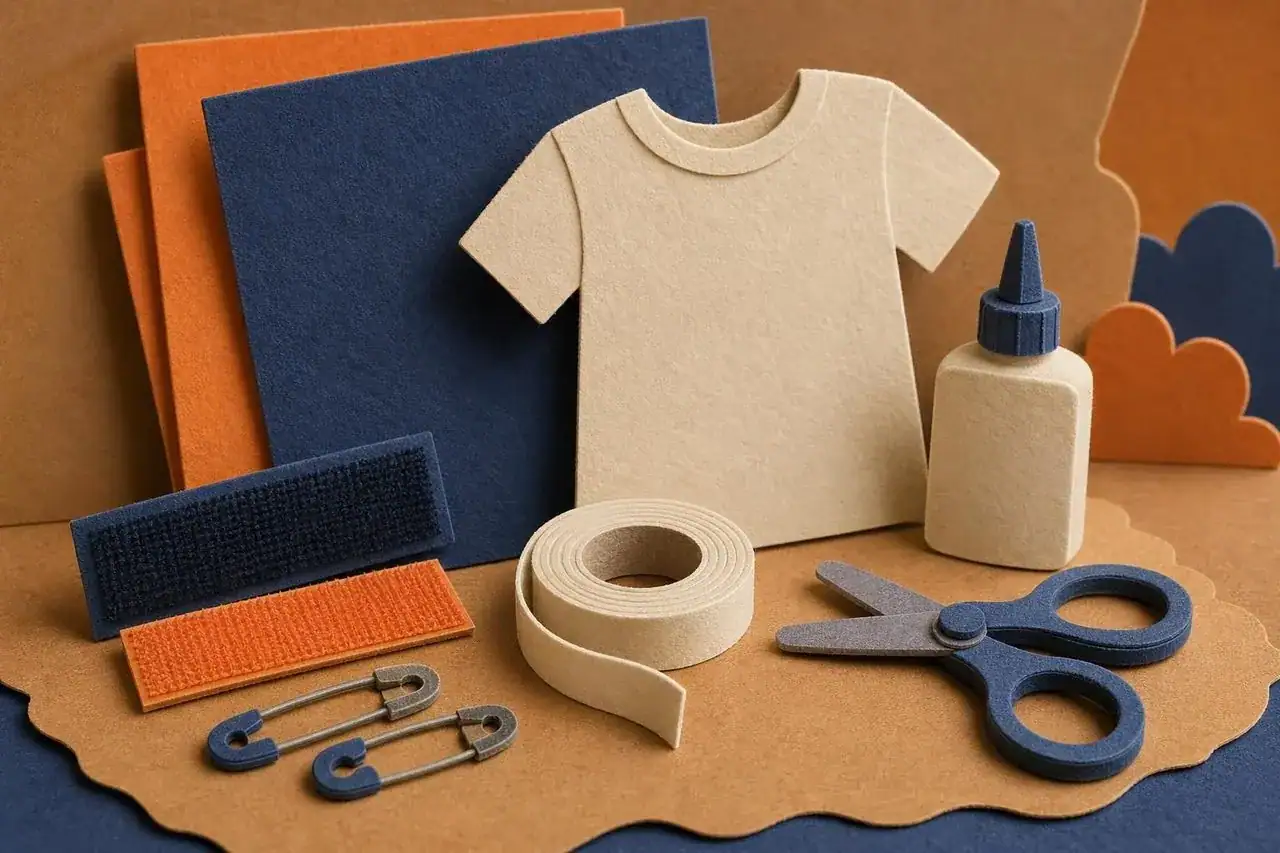
- Felt: does not fray, cuts cleanly and glues easily. Good for capes, tabards, ears, crowns and emblems.
- Fabric glue: a washable, flexible glue that bonds cloth to cloth. Allow the manufacturer’s drying time before wearing.
- Safety pins: quick and reversible, but use them on the inside and cover the points. Avoid them on toddler costumes.
- Iron-on tape: an adult task, but clean and fast for hems.
- Elastic and ribbon: tied or knotted ties replace stitched fastenings. Use soft elastic for headbands and wrists.
- Cardboard and tape: carton cardboard turns into armor, wings, crowns and props.
- Recycled clothing: old T-shirts, pillowcases, vests and aprons are already shaped and stitched.
The no-sew cape guide is a good first build, and a child can make most of it.
Comfort and sensory-friendly costumes
Some children refuse a costume not because of the idea but because of how it feels. Think about the sensory side before you build.
- Fabrics: choose soft, flexible materials, and cut out tags. Put a smooth T-shirt under anything scratchy, such as felt or cheap synthetic fabric.
- Fit: loose is easier than snug. Avoid tight collars, headbands, hoods and masks if the child dislikes them.
- Temperature: layer for the weather, and avoid thick padding indoors.
- Sound and sight: some children dislike rustling fabric, bells or glitter. Remove anything that bothers them.
- Trial runs: let the child wear the costume at home for short stretches and build up. A short trial run reveals problems early.
- Escape routes: build in an easy way to take it off, and tell the child they may.
- Options: a themed T-shirt, a badge, a hat or a face-paint design can stand in for a full costume.
Never force a costume that causes distress. A child who enjoys a simple outfit has a better time than one in a showy outfit they hate.
Inclusive and adaptive costumes
Costumes can be adapted for any child, and the best adaptations are fun and part of the design.
- Wheelchair users: turn the chair into the costume. A race car, a spaceship, a fire engine, a pirate ship or a throne all work with cardboard, paint and tape. Keep fabric clear of the wheels and brakes, and keep joystick controls, straps and cushions accessible.
- Children who use walkers or crutches: decorate the aid or attach elements to the clothing, and avoid long hems that could catch.
- Children with limited hand dexterity: use large buttons, hook-and-loop fasteners, pull-on pieces or elastic, so they can dress with little help.
- Children with feeding tubes or medical devices: plan around access, and talk with the family. Never cover anything that must stay visible or reachable.
- Children with hearing or vision differences: avoid hoods and masks that muffle sound or narrow the view, and choose high-contrast colors.
The principle is simple: ask the child and the family. They know what works. Costumes that reflect the child’s personality and equipment are far more fun than ones that hide it.
Safety for kids costumes
The basics are simple, and the full costume safety guide goes deeper.
- Visibility: pick light or bright colors, and trim costumes, shoes and bags with reflective tape. Carry a flashlight or glow stick.
- Masks: eye and nose holes need to be big enough for full vision and easy breathing. Face paint is often a better option.
- Fire safety: look for flame-resistant labels on costumes, and keep children away from candles and open flames. Avoid baggy sleeves and billowing skirts near them.
- Trip hazards: hems and capes should clear the ground. Check shoes fit and are comfortable.
- Small parts: buttons, beads and loose decorations are choking hazards for toddlers. Attach things firmly.
- Capes and ties: use hook-and-loop or breakaway fastenings so nothing tightens round the neck if it catches.
- Face paint: use paint labeled for skin, do a patch test, keep it out of the eyes and wash it off before bed.
- Props: keep swords, wands and tools soft, short and blunt. Foam and thick cardboard with rounded edges are better than anything rigid or pointed.
- Tools: adults handle hot glue and craft knives.
School parades and dress-up days
A school event needs a costume that works in a classroom, not just on a street.
- Check the rules. Many schools ban masks, weapons, fake blood and anything that hides the face. Look at the instructions before you start.
- Plan for the day. Can the child sit at a desk, use the bathroom, climb on play equipment? Avoid wide capes, long tails and rigid headpieces.
- Label everything. Write the child’s name on every piece, including props and shoes.
- Choose a base layer. A costume made over a regular shirt and trousers can be removed for gym or art.
- Pack a spare bag. Include safety pins, tape, a spare headband and a plain outfit for changing.
- Think about the parade route. A long walk calls for comfortable shoes and weather-appropriate layers.
- Ask about allergies. Check for latex, face paint and any other restrictions in the classroom.
Book characters, community helpers, animals with ears and tails, and historical figures all suit school days well, and the costume calendar lists the dress-up days that recur through the school year.
Group and sibling costumes
Siblings and friends enjoy matching themes. A few examples:
- Farmyard: a farmer, cow, sheep and scarecrow.
- Crayon box: plain colored tops with a cone paper hat.
- Pirate crew: a captain, first mate and cook.
- Zoo: one animal each, with ears, tails and face paint.
- Fairy-tale cast: a wolf, a red hood, a woodcutter and a grandmother.
Give each child a part they like, and avoid assigning the boring role to the youngest. Siblings of different ages can wear the same theme at different levels of effort.
When something goes wrong
Costumes fail, and a few quick repairs help.
- Torn felt: glue a patch behind the tear.
- A hat that slips: add a soft elastic chin strap or hair clips.
- Droopy ears: glue a strip of cardboard along the back.
- Wet paint: let it dry fully before wearing, since wet paint smears onto clothes and skin.
- Child refuses to wear it: drop the part that bothers them, and keep the rest.
Keep a small repair kit with tape, safety pins, glue and spare elastic.
Easy kids Halloween costumes for trick-or-treating
Easy kids Halloween costumes start with a warm layer, a bright color and one hero item such as ears, a cape or a paper crown. Homemade versions beat flimsy ready-made outfits for comfort, because they go over a coat and can be adjusted on the spot. Most no sew kids costumes, from a ghost to a cat, take under thirty minutes, and these DIY kids costumes go straight into the dress-up box afterward. Add reflective tape, keep hems off the ground and check that no mask or hood blocks the child’s view.
Costumes for rainy or cold evenings
Evening events in autumn are often cold or wet, and many children end up hiding a costume under a winter coat. Plan for it from the start. Build the costume to go over a warm layer, or make the coat part of the design: a coat painted as a firefighter’s jacket, a hooded coat with ears for an animal, a cape over a puffer jacket. Choose gloves and hats in a color that suits the character. Skip paper pieces that soften in the rain, and use felt, fleece or sealed cardboard instead. Check that a bulky layer does not hide the reflective trim.
Treat bags and props that go with the costume
The bag or basket is part of the costume. A pumpkin pail, a cardboard treasure chest, a felt knight’s pouch or a paper-bag lunchbox for a robot ties the outfit together and gives a small child something to hold. Keep props light, because a child will drop anything heavy, and make handles soft and long enough to carry comfortably without dragging. Add reflective tape to the bag as well as the clothes, and keep wands and swords short enough to carry without hitting other children. If the child gets tired, a prop that clips or ties to the costume is easier to manage than one carried in hand.
Handing a costume down
Kids outgrow costumes quickly, which makes a swap one of the best ways to keep costs low. Wash what can be washed, repair loose seams and glue, and pack each costume with its accessories in a labeled bag. Share the bag with a younger sibling, a neighbor or a school collection. Receiving families can alter a hand-me-down with a new emblem, a different headband or fresh paint, so the same base becomes a different character.
Where to go next
For more ideas by theme, return to the costume ideas guide. To build the pieces, read the DIY costumes guide. For a quick shortlist, use the costume idea finder, and for safe finishing touches, see costume makeup and costume accessories.
Questions people ask
What are the easiest kids costumes to make at home?
How do I make a kids costume with no sewing?
What is a good costume for a toddler?
How can I involve my child in making their costume?
How early should I start a child's Halloween costume?
Are masks safe for children?
How do I keep a child visible at night?
What can I do if my child hates costumes or sensory itchiness?
What are good costumes for a child in a wheelchair?
What are good costumes for a school parade?
What are good costumes for 8 to 12 year olds?
How do I make a costume that lasts the whole evening?
Is face paint safe for kids?
How do I make a costume for a teenager who thinks costumes are childish?
How can I make a cheap costume for my child?
What should I do with a costume after the event?
Keep going