Make your own Poison Ivy costume
A DIY Poison Ivy costume with leaf-covered green clothes, vine accents and a red wig: materials, steps with reasons, kid-friendly and adult versions, safety.
A DIY Poison Ivy costume is a good project for someone who likes crafting but not sewing. The look comes from three things: green clothes, a lot of leaves and a head of red hair. This guide walks through the materials, each step with the reason behind it, and how to adjust it for a child, a teen or an adult.
The outfit is inspired by a comic book character and is built at home with plain materials. There are no official pieces involved, so you can choose how much coverage, shine and vine you want.
Quick facts
| Child version | Adult version | |
|---|---|---|
| Time | 4 hours, plus overnight drying | 5 to 6 hours, plus overnight drying |
| Difficulty | Easy | Medium |
| Rough budget | A few dollars of felt and glue if you already own green clothes | Slightly more, mostly for the wig |
| Skills | Cutting, gluing | Cutting, gluing, wig styling |
Budgets depend heavily on what is already in your closet, so treat these as rough guides.
Materials
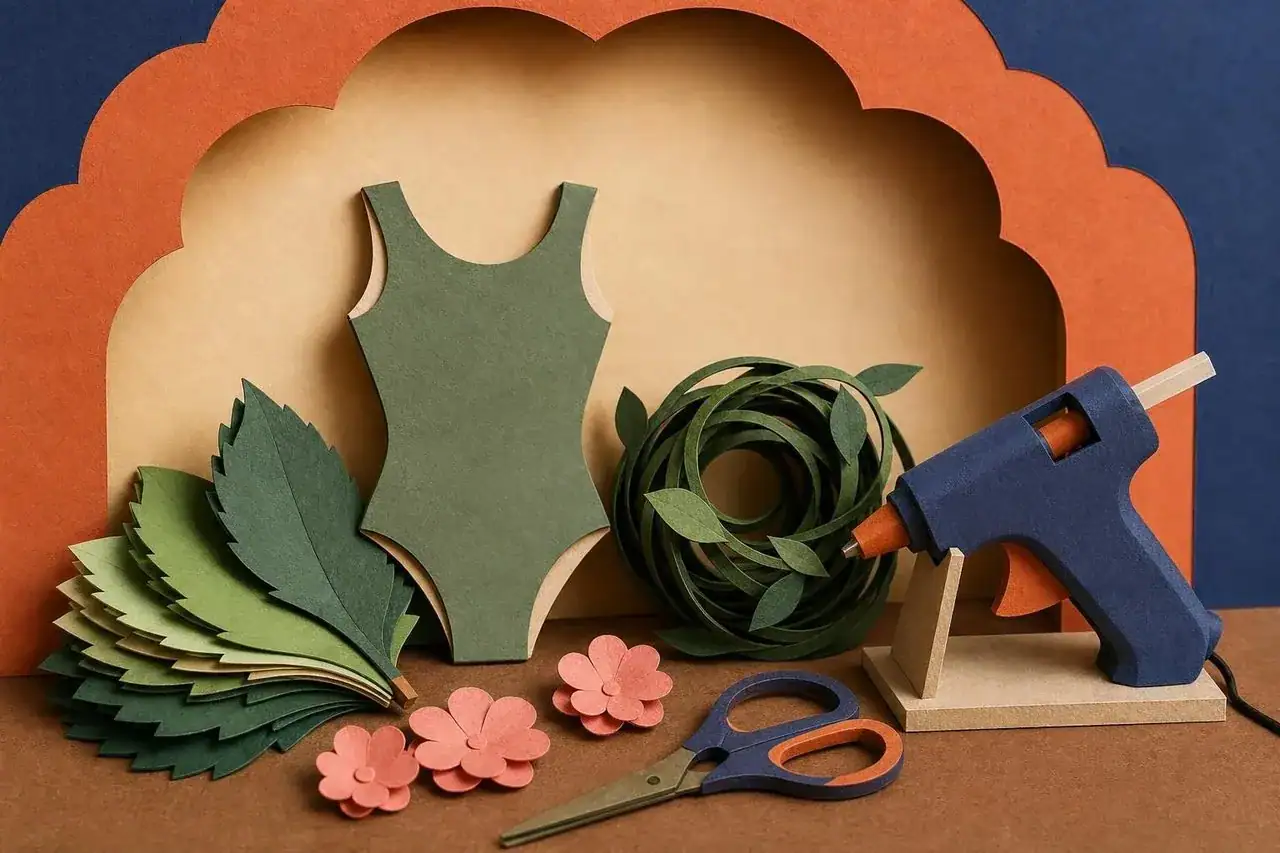
- A green base: dress, leotard, or long-sleeved top with leggings, in a cotton or jersey fabric
- Felt in three or four shades of green, about 8 to 10 sheets for a full look
- Fabric glue, plus a hot glue gun for adults for stems and vines
- Green pipe cleaners, thin green ribbon or soft cord for vines
- Optional wire (florist or craft wire) wrapped in tape for stiff vines on adult builds
- A red or auburn wig, headband or wrap
- Small fabric flowers in pink or red for accents
- Scissors, a pencil, paper for leaf templates, safety pins
Step by step
1. Plan where leaves go
Lay the base on a table and mark leaf areas with chalk or a washable pen: shoulders, waist, hem and one sleeve. Why: concentrated leaf clusters look intentional, while leaves spread evenly can look like a rug.
2. Make leaf templates
Draw three leaf shapes on paper: a small rounded one, a medium pointed one and a large one with a notch. Cut about 40 to 60 leaves total across your shades. Why: variety in size and tone is what makes felt look like foliage.
3. Glue the first leaf row
Starting at the hem or lowest area, glue a row of leaves with only the top edge fixed, so the lower tips stay loose. Let each row set before the next. Why: layering from the bottom up hides the glue lines, just as roof tiles do.
4. Build upward and add overlap
Work up in overlapping rows, rotating the leaf direction slightly. Press each leaf flat for 30 seconds. Why: pressing prevents the corner curl that gives a cheap look.
5. Add vines
Twist pipe cleaners or wrap cord into long vines, glue them along seams and let the ends curl across the shoulder or arm. Why: vines cover the cut edges where leaves meet and add movement.
6. Add flowers
Glue two or three small flowers among the leaves, mostly near the neckline and hip. Why: a pop of pink or red against green draws the eye and breaks the repeating pattern.
7. Style the hair
Fit the wig, comb it for volume and add a few leaf clips or a small vine near one ear. Pin it at the temples and nape. Why: red hair against green is the strongest visual cue, so it deserves care.
8. Test and trim
Put it on, move, sit, bend and lift your arms. Trim any stray leaf that catches and re-glue loose edges. Why: an afternoon of walking will find every weak spot.
Common mistakes
- Using hot glue directly on stretchy fabric, which hardens into stiff patches and tears the knit
- Covering the whole outfit in leaves, which causes overheating and leaves little room to move
- Choosing shiny satin, which shows every glue mark
- Using wire with sharp ends near the face or hands
- Collecting real leaves from outdoors instead of using fake ones
Safety notes
Never use real Poison Ivy, poison oak or poison sumac. The plant oil causes a painful rash, and wearing it against skin is dangerous, so only craft leaves belong here. Hot glue burns, so keep it away from children, and let it cool before touching. Wire vines need taped ends and should stay clear of eyes. Makeup must be labeled for skin, patch tested a day ahead and kept away from the eye area unless the product allows it. The makeup guide explains the details. Wigs should not block peripheral vision.
Adapting for a child
Use a plain green dress, felt leaves glued rather than sewn and ribbons instead of wire. Make the leaf coverage modest, keep the wig light or replace it with a headband and red yarn, and let the child choose where the flowers go. Check for small parts like loose buttons and flowers on very young children.
Adapting for an adult
A fitted base such as a jersey dress or bodysuit gives a cleaner line. Use wire-core vines for movement, and add a fine shimmer along the leaf edges if you like. Wear breathable layers under the costume, and pack a few safety pins for repairs. Bring the wig in a bag if the venue is hot.
Variations
For a simpler version, wear a green top with leaf clusters only on one shoulder and one hip. For a group costume, pair it with a cardboard knight or a hero from the superhero costume ideas. A red wig and a few accessories can turn a basic green outfit into a full character. For more projects like this, see the DIY costumes index.
Finishing and wear
Let all glue cure overnight before wearing, check each leaf edge once more and make sure the outfit is comfortable for the full evening. If you plan to dance, test it at home first for five minutes.
Choosing the greens
Three or four shades give the best result: a dark forest green for the base leaves, a mid green for the main layer and a light yellow-green for highlights. Cut more of the mid shade than the others, and place the light leaves where the light would hit, along the shoulders and the top edges. A single flat green looks like a pile of paper, while mixed greens look like growth.
Making the outfit last
Felt leaves peel at the tips first, so add a dot of fabric glue under each loose tip after the first wear. If you plan to wear the costume more than once, store it flat with tissue between layers and avoid folding across the leaf rows. A quick touch-up with fabric glue is easier than rebuilding a section.
Group and couple ideas
Plant characters pair well with others. A group might include a gardener with a straw hat and apron, a bee made from yellow and black stripes, or a few flowers in single-color dresses. Match the leaf shades across the group so the outfits look like parts of one garden.
Questions people ask
How long does a DIY Poison Ivy costume take?
What can I use for leaves if I do not want to sew?
Is this the official Poison Ivy outfit?
Can a child wear a Poison Ivy costume?
How do I make vines that stay in place?
What hair works best for the look?
Is there a risk of looking like Poison Ivy the plant?
What makeup suits this costume?
How do I keep it comfortable in a warm room?
How do I store the costume afterwards?
Keep going