A short history of the costume
A short, fact-checked costume history: festival masks, Greek theater, carnival, Halloween guising and the rise of cosplay, with the ideas behind each look.
Dressing up is older than any record of it, and it has never been one thing. People have worn masks in ritual, in the theater, at festivals and, more recently, at conventions. This short costume history follows the traditions that can actually be traced and leaves out the ones that cannot. It is a map of where today’s costumes come from, with pointers to the looks you can build yourself.
Why people dress up
A costume lets someone step out of their ordinary role. It can be a god in a ritual, a servant in a comedy, a ghost on a doorstep or a favorite character at a convention. The reasons change by period, but the habit stays the same: put on a different face, and behave a little differently.
No one can say when this began, because the earliest examples left little behind. What follows starts where the evidence is firm.
Festival masks and the ancient Greek stage
Greek theater grew out of festivals for Dionysus, the god of wine and song. At festivals such as the City Dionysia in Athens, tragedies and comedies were performed in front of large crowds. By the fifth century BCE, masks were a standard part of the performance.
Masks did practical work. A small number of actors, all men, played every role, so a change of mask meant a change of character, including women and gods. The painted expressions helped the audience understand the character from far away. A tragic mask and a comic mask have since become the best-known symbols of theater itself.
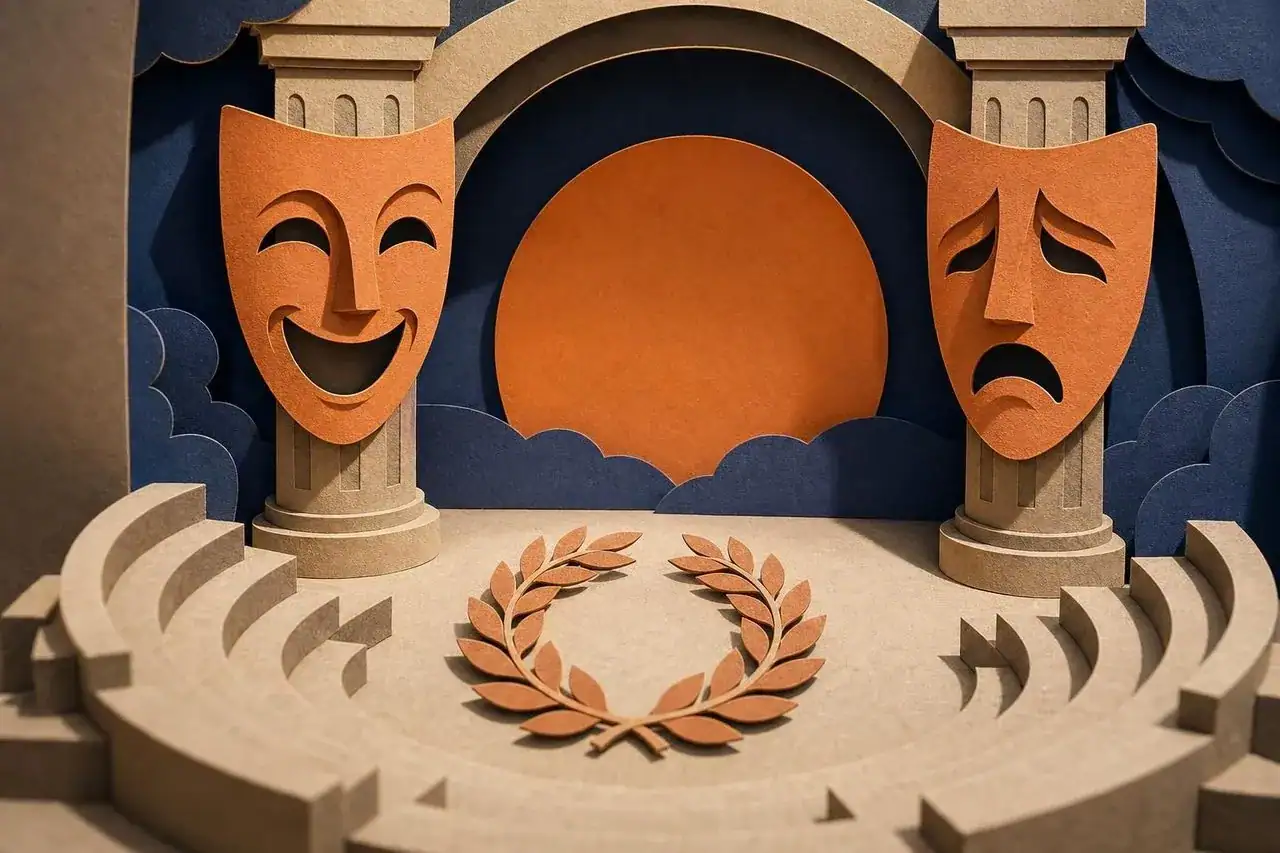
For a modern costume, the lesson holds: big, simple shapes read best at a distance.
Theater costume and commedia dell’arte
Italian commedia dell’arte developed through traveling companies of actors playing stock characters, and its masks became popular in the sixteenth century. The characters were recognizable types, not individuals, and many wore half-masks that left the mouth free for speaking.
Arlecchino, called Harlequin in English, is the best known. Traditional masks for the character were black with a red spot on the forehead. The servant types known as zanni had low brows and long noses. Mask makers worked in leather, papier-mache and other materials.
These costumes show a principle that still guides costume design. A character is defined by a few strong visual markers, and an audience reads them in a second.
Carnival and masquerade
Carnival is the festive season before Lent, the Christian period of fasting. It ends on Mardi Gras, French for Fat Tuesday, which is always the Tuesday before Ash Wednesday. Parades, music, feasting and costume are part of it in many places, including Venice, parts of Europe and Latin America, and New Orleans in the United States.
The mask is central because it gives people a license to change roles for a few days. The same spirit shows up in Venetian masks, in parade floats and in the masquerade ball.
Dress is also part of Purim, the Jewish holiday that recalls the story in the Book of Esther. Dressing up there is often connected to the theme of hidden identity in the story, and some writers link it to the masquerade customs of the Italian carnival season. If you plan a Purim look, treat the holiday with the respect you would give any religious tradition.
Halloween’s costume tradition
Halloween’s costumes come from more than one source, and historians still argue about how directly they connect.
- Samhain. An ancient Celtic festival marking the end of summer, often placed around the start of November. Popular accounts link it to the idea that the boundary between the living and the dead grew thin, and to disguises worn to hide from spirits.
- Souling. In medieval Britain, poor people and children went door to door around All Souls Day asking for soul cakes in exchange for prayers.
- Guising. In Scotland and Ireland, children dressed in costume and went from house to house from about the sixteenth century, performing a song, poem or trick for fruit, nuts or coins.
These customs traveled and merged, and the version most families know today, with children going door to door in costume, is a descendant of them. If you want a Halloween look with real roots, start from the older figures: ghosts, witches and spirits. The witch and wizard costumes page is one place to begin, and the holiday trivia article covers more seasonal facts.
Costume as scholarship: films and monsters
Modern costume is also built from stories. Classic film monsters, villains and sci-fi heroes gave dressers a set of silhouettes that everyone knows. For a look at how those characters became icons, see horror villains and monsters.
The rise of cosplay
Cosplay, short for costume play, has a clear paper trail.
- 1939. At the first World Science Fiction Convention in New York, Forrest Ackerman and Myrtle Douglas are widely credited with arriving in costumes inspired by the film Things to Come. More fans joined in at the next convention.
- 1984. Nobuyuki Takahashi, a Japanese writer, saw costumed fans at the World Science Fiction Convention in Los Angeles and coined the word cosplay for a magazine article. The word follows a Japanese habit of shortening two words and joining them: costume becomes kosu and play becomes pure.
Since then the hobby has grown into a worldwide craft, with makers building armor, wigs and props from foam, fabric and thermoplastics. If you want to meet other makers, the communities to follow article is a good start.
What costume makers inherited
Each tradition above left behind techniques that home makers still use. Theater taught that exaggeration reads at a distance. Carnival and masquerade made the half-mask a classic: it covers the eyes and brow, keeps the mouth free and is simple to make from card, felt or papier-mache. Guising, with its songs and tricks, is a reminder that a costume works best when the wearer does something in character. And cosplay brought a craft culture in which makers share patterns, test materials and compare finishes.
Costume and the calendar
Many of these traditions are tied to a season. The costume calendar shows which holidays and events invite dressing up and roughly when they fall.
Building a historical look
Historical costume is easier than it looks if you follow a few rules.
- Pick one period and one social class, and study what an ordinary person of that time wore, not just the court.
- Start with the silhouette: the shape of the hat, the sleeve and the skirt do most of the work.
- Use the right fabrics for the look, such as linen and wool for earlier periods, before adding trim.
- Accept that stage and carnival costume exaggerate, and decide whether you are making a reconstruction or an impression.
The historical costumes page has ideas by period, and the costume ideas guide lists every theme.
Build something with a past
Pick a tradition above and start from its signature piece: a bold half-mask, a pointed hat, a painted tragic or comic face, or a film-inspired space suit. A clear silhouette and one strong item carry a look in every period.
Questions people ask
When did people first start wearing costumes?
Why did ancient Greek actors wear masks?
What is carnival and why do people wear masks?
Where does the tradition of Halloween costumes come from?
What was commedia dell'arte?
How did the word cosplay start?
Who were the first cosplayers?
What is the difference between a costume and a uniform?
Why do people dress up for Purim?
How has costume making changed over time?
Are historical costumes always accurate?
How can I learn more about historical dress?
Keep going