The scariest scenes in horror
The scariest horror movie scenes explained as craft: suggestion, sound and timing in Psycho, Jaws, The Haunting and more, plus safe costume ideas.
Ask people for the scariest horror movie scenes and they rarely name the loudest or the bloodiest. They name the moments that made them look away, hold their breath or check the hallway. This page takes a craft approach: what the filmmakers actually did, why it works, and how a costume-maker can borrow the idea in a way that is playful rather than gruesome.
What makes a scene scary
Across decades and countries, effective scares tend to rely on a handful of tools.
- Withholding. Not showing the threat leaves the audience to imagine it.
- Sound. Music, silence and noise tell the viewer what to feel.
- Point of view. Seeing through the monster’s eyes or the victim’s makes the audience complicit.
- Ordinary places. A bathroom, a bedroom, the sea on a sunny day. Fear works best where people expect to feel safe.
- Timing. The pause before the event often matters more than the event itself.
None of these requires gore, and the scenes below show why.
Psycho (1960): the power of the cut
The shower scene in Psycho is one of the most analyzed sequences in cinema. It was shot over about a week in December 1959 and built from many brief, close shots. The film shows almost none of what it suggests; viewers feel it through editing. Alfred Hitchcock first planned the scene without music, but composer Bernard Herrmann wrote a piece for screeching strings and persuaded him to use it. Saul Bass, who designed the film’s title sequence, is credited with storyboarding it.
What to take from it: the audience supplies the detail. For a costume, that translates into restraint. A plain cardigan and a calm expression can unsettle people more than any amount of fake makeup.
Jaws (1975): the shark you hardly see
The mechanical shark in Steven Spielberg’s film was nicknamed Bruce, and it kept malfunctioning, partly because it had been built for fresh water and was used in the sea. The great white ends up on screen for only a few minutes. For the rest of the film it is suggested by point-of-view shots, by John Williams’ famous theme and by sharp editing. Spielberg has said that the shark not working helped the film.
What to take from it: the sound can be the monster. If you want a Jaws costume that is funny rather than frightening, a cardboard fin hat and a two-note hum does the job without any scare at all.
The Haunting (1963): a door that breathes
Robert Wise’s The Haunting has a scene in which two women hear pounding that travels down the house toward their door, followed by a stretch of quiet during which nothing is visible and only breathing is heard. No ghost appears. The sound design, led by Desmond Briscoe, who had worked at the BBC Radiophonic Workshop, and the actors’ reactions carry the whole scene. This approach is often linked to the producer Val Lewton’s earlier films, which also favored what is unseen.
What to take from it: reaction is a special effect. In a group costume, one person staring at an empty doorway is enough to tell a story.
Halloween (1978): the figure at the edge of the frame
John Carpenter’s film uses wide frames in which a pale figure stands in the background, motionless, while the main character carries on with her day. The scare is that the viewer notices before she does. No sound is needed, and the effect works on a second watch because you know where to look.
What to take from it: a figure standing still can be more unsettling than a figure moving. For a costume photo, stand quietly in a doorway or in the back of a group shot.
Nosferatu (1922): a shadow on the stairs
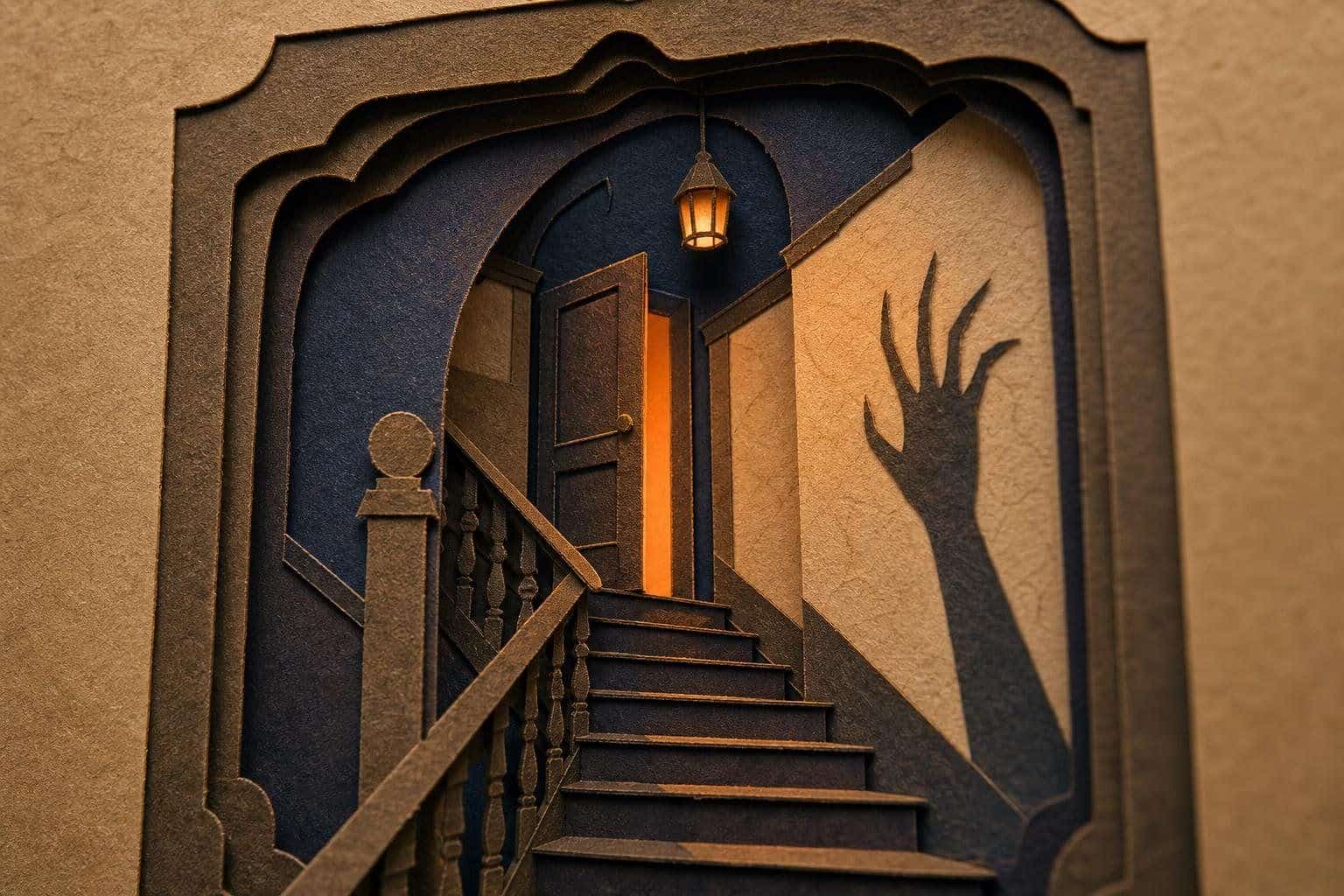
F. W. Murnau’s silent film has a famous moment in which Count Orlok’s shadow slides up a staircase before the figure itself is seen. With no sound at all, it relies on lighting and the exaggerated shape of long fingers and a stooped back. It is a lesson in how little you need: a shape, a light and a wall.
What to take from it: silhouette is a costume. A cardboard cut-out of a shadow hand on a stick, held up against a wall with a lamp behind it, is a safe and effective party trick.
The Blair Witch Project (1999): the camera as a character
The film presents itself as footage recovered after three students disappeared while making a documentary in the woods near Burkittsville, Maryland. The handheld camera, the limited view and the lack of a polished score make events feel immediate. The film’s reported budget has been quoted in different ways, but it was very small by studio standards, and its success helped popularize the found-footage style.
What to take from it: the limit is the scare. If you can only see a few feet ahead, the dark does the work. For a costume, a hiking jacket, a backpack and a prop camera is a recognizable, gentle nod.
Why the best scenes age well
The scariest horror movie scenes tend to be the quietest ones.
Gore dates quickly because techniques improve. Suggestion does not, because it depends on human imagination. That is why scenes from 1922, 1960 and 1975 still work on audiences today. They are built from shapes, sounds and pauses rather than shocks.
How to analyze a scene yourself
You do not need a film degree to see how a scene works. Try this next time a scary moment lands.
- Mute it. Replay the scene with the sound off. How much of the fear disappears? If most of it does, the sound design was doing the work.
- Count the cuts. A frantic scene often has rapid cuts, and a slow one has long, patient shots. Neither is better, but the contrast tells you what the director wanted you to feel.
- Find what you cannot see. Look for the edges of the frame, the dark corners and the doors that are closed. The scariest thing is often just out of shot.
- Notice where you looked. Did the camera lead your eye, or did you spot something on your own? Films that let the audience notice first, as in Halloween, feel more personal.
This exercise is also a nice activity for a class or a teen film club, and it needs no gore at all.
A scene-inspired photo shoot
A costume is often worn for a few hours and photographed for years, so it is worth planning a shot that borrows from these scenes.
- The shadow shot. Place a lamp low behind the wearer so a long shadow stretches up a plain wall. Choose a costume with an exaggerated outline, such as a cape with a pointed hood or a hat with a wide brim.
- The doorway shot. One person stands motionless in a doorway while another carries on with a normal task in the foreground. It is funny, spooky and easy to stage.
- The explorer shot. Pair hiking gear with a prop camera and a flashlight, and shoot from a low angle with a lot of dark around the subject.
- The beach shot. Daylight, a towel and a cardboard fin passing behind the swimmer. Silly, safe and recognizable.
Shoot in daylight or with battery lights, keep stairs clear of costumes with long hems, and let anyone who feels uncomfortable step out of the picture.
Common mistakes in scary costumes
- Showing everything. A costume with too many details looks cluttered. Choose one strong element and let the rest be simple.
- Ignoring comfort. A heavy mask or hot fabric ruins an evening. Test it indoors for fifteen minutes before the event.
- Poor visibility. Eye holes that are too small are the most common problem. Cut them bigger than you think you need.
- Loose materials near flame. Candles, fireplaces and kitchen stoves do not mix with capes and cotton gauze. Use LED lights.
- Forgetting the audience. A small child, a nervous guest or a pet can be frightened by a sudden figure in the dark. Say hello first and take the mask off if someone seems upset.
Costumes that borrow the craft, safely
You do not need to frighten anyone to use these ideas.
- Use silhouette. A long hooded cloak or a simple black outfit with a single bright accessory reads at a distance. Shorten the hem to avoid tripping.
- Add light with LEDs. Battery-powered tea lights or a small LED strip sewn into a cuff look striking in the dark and are safer than candles. Never use real flame near fabric.
- Use sound gently. A small bell or jingle on a cuff makes a character noticeable. Keep it quiet enough that it will not cause discomfort in a crowd.
- Keep the face clear. If you wear a mask, test your sight lines. For makeup, use products made for skin and patch-test first. The costume makeup guide explains how.
- Know your audience. Younger children can be frightened by anything that looks sudden or dark. Introduce the costume in daylight before an event.
For fabric, mask and visibility advice, see the costume safety guide.
Where to go next
The scariest horror movie scenes are good teachers for anyone who makes costumes, because they show how much a single shape can say. Return to the horror villains and monsters guide for the rest of the series. Horror villains and where they came from looks at the figures behind many of these scenes, and classic movie monsters goes back to the 1930s. If you want to build something, the costume accessories guide covers hoods, props and lighting.
Questions people ask
Why are suggested scares often more effective than shown ones?
How was the shower scene in Psycho made?
Why is the shark in Jaws barely seen?
What is the famous scene in The Haunting?
What does found footage mean?
How does music make a scene scarier?
Can children watch classic scary scenes?
What is a jump scare?
Which silent film introduced the famous shadow on the stairs?
How can I create a spooky effect in a costume without gore?
Keep going