Surprising facts about holidays and costumes
Holiday trivia you can check: Halloween guising, the first trick-or-treat, Thanksgiving's date change, early valentines and a banned Christmas.
Holidays collect facts the way attics collect boxes: some are charming, some are false, and a few are better than the myths. The items below are holiday trivia that can be traced to reliable records, along with the costumes and customs that grew around them. Anything that could not be confirmed was left out.
Halloween: older than the candy
The name
Halloween is a contraction of All Hallows’ Eve, the night before All Hallows’ Day on November 1. The festival draws on autumn customs from Ireland, Scotland and other parts of Britain, including the Celtic festival of Samhain, which marked the end of the harvest and the beginning of the darker half of the year.
Dressing up came first, the sweets came later
Dressing in costume to go door to door is much older than the candy. Records of guising in Scotland go back to the sixteenth century, and similar customs, including mumming and costumed visits for food and drink, were found in Ireland, Wales and the Isle of Man. On All Souls’ Day in the British Isles, groups of poorer people, often children, went from house to house asking for soul cakes in exchange for prayers for the givers’ dead relatives.
So when a child holds out a bag in a costume, they are following a tradition that is at least several hundred years old.
Before pumpkins, there were turnips
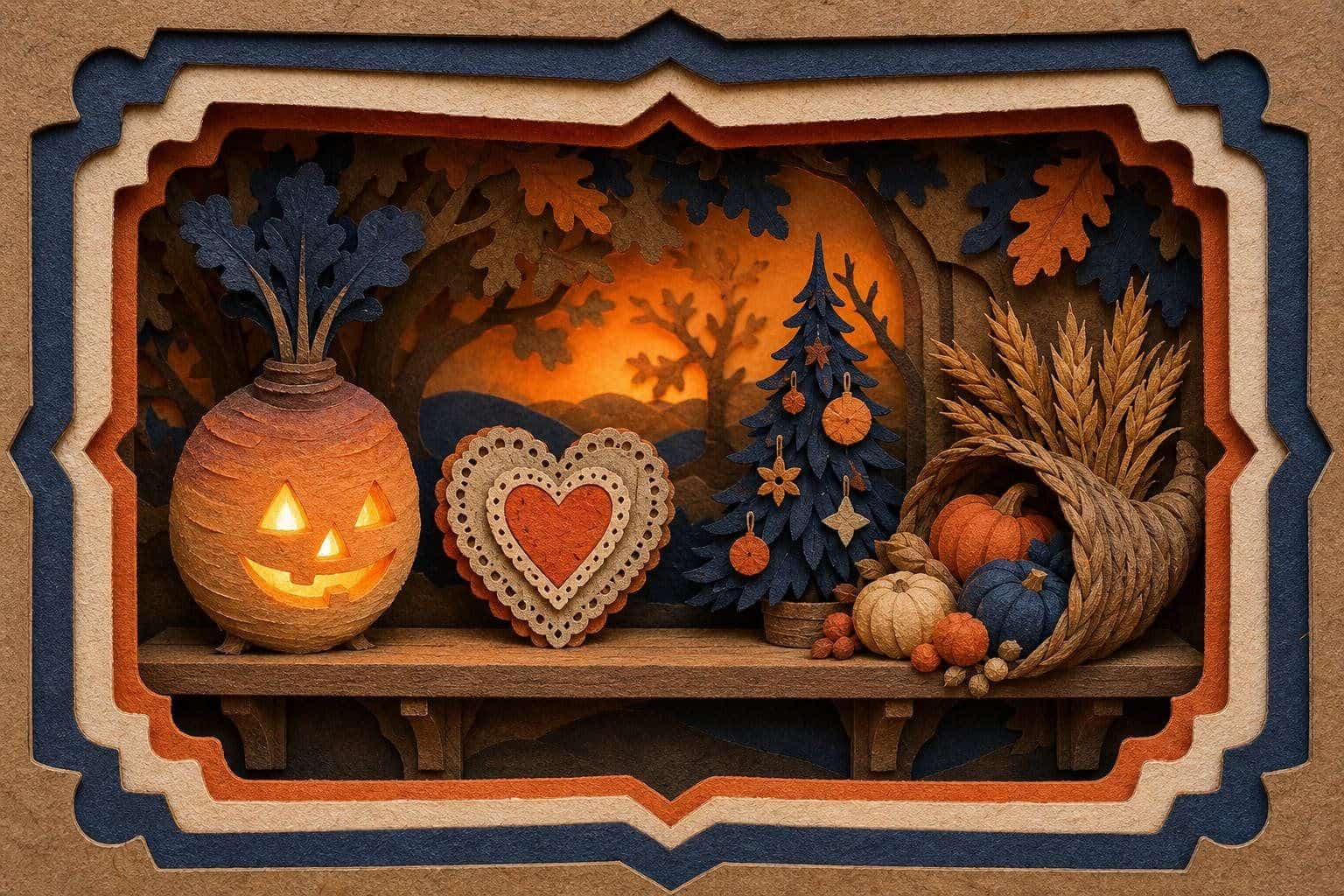
Jack-o’-lanterns started in Ireland and Scotland, where people carved faces into turnips, beets and potatoes and set them near doors and in windows. The name comes from the Irish folktale of Stingy Jack. Irish immigrants brought the practice to North America, where the native pumpkin proved larger, softer and easier to carve.
When “trick or treat” first appears
The earliest printed use of the phrase found so far is from 1927 in Alberta, Canada: the Calgary Daily Herald mentioned it on November 3 of that year. The practice of going door to door is far older than the phrase, which is a good reminder that names often arrive late.
Costume angle: a turnip-lantern headpiece is a great, unusual build. Make the base from a paper bag or papier-mache, paint it pale yellow-green, and add a face and a handle. Use a battery LED, never a candle.
Thanksgiving: the date that moved
Abraham Lincoln made Thanksgiving a national holiday by proclamation in 1863, fixing it on the last Thursday of November. In 1939, Franklin D. Roosevelt moved it a week earlier to give retailers a longer holiday season during the Depression, and the change was unpopular enough to earn the nickname Franksgiving. In 1941 Congress passed a joint resolution that Roosevelt signed, establishing the fourth Thursday of November as the legal date.
The first Macy’s parade was held in 1924. It featured live animals from Central Park Zoo and was billed as a Christmas parade.
Costume angle: Thanksgiving costumes are mostly simple, school-friendly builds. A paper hat, a felt turkey tail or a harvest-themed headband work well. Be careful with fabric near candles and stoves at the dinner table.
Valentine’s Day: poems and paper lace
One of the oldest known valentine poems is credited to Charles, Duke of Orléans, who wrote it in French while a prisoner in the Tower of London after the Battle of Agincourt in 1415. The poem is held in the British Library. It was written in the context of a court custom in which men and women were paired, and in it he tells his young partner that he is already tired of love, so it is a gentler, funnier piece than most people expect.
Much later, in 1849, Esther Howland of Worcester, Massachusetts, introduced high-quality, mass-produced valentines in the United States. She had studied the lace-covered cards that her father’s bookstore imported from England, and her versions used layers of lace, colored paper and sometimes mechanical effects. She is known as the Mother of the American Valentine.
Costume angle: a Cupid costume is one of the easiest holiday looks: felt wings, a cardboard bow and a pair of red tights. Make wings from two stiff card shapes covered in felt and attach them with elastic straps so nothing pulls on the neck.
Christmas: banned, then beloved
In 1659 the General Court of the Massachusetts Bay Colony passed a law imposing a fine on anyone observing Christmas by not working, feasting or any other way. The Puritans who led the colony viewed the day as having no biblical authority and as an occasion for excess. The law was repealed in 1681 under pressure from London. Christmas became a federal holiday in the United States in 1870, during the presidency of Ulysses S. Grant.
A popular myth says that Coca-Cola invented the red-suited Santa. The company did make that image extremely well known, but it did not invent it. Santa had been drawn in red before the company’s advertising, and the illustrator Thomas Nast, who worked for Harper’s Weekly in the nineteenth century, helped shape the modern figure. The company itself has credited his earlier work.
Costume angle: Santa, elves and winter characters appear in the Christmas costumes guide, including simple felt and fleece builds that are safe around candles and trees.
Costume ideas that come straight from the facts
Trivia makes good costume material because each fact has a visual hook.
| Fact | Costume it suggests | Key element |
|---|---|---|
| Jack-o’-lanterns began as turnips | Turnip lantern headpiece | Pale yellow-green dome, carved face, LED glow |
| Guisers went door to door in disguise | A simple costumed visitor with a bag | Mask or face paint, a rhyme to recite |
| Soul cakes were given for prayers | A village baker or visitor with a basket | Apron, basket, round paper cakes |
| Thanksgiving moved to the fourth Thursday | A calendar costume | Cardboard calendar tabard with the date circled |
| Valentines used lace and paper layers | Layered paper valentine | Doily trim, cardboard heart, ribbon |
| Christmas was fined in 1659 | A Puritan-style figure | Plain dark clothes, white collar, white cap |
Most of these use cardboard, felt and paper, which keeps the cost low. The Puritan-style look in particular needs only a dark jacket, a white collar cut from card or fabric and a plain hat.
Safety notes for holiday costumes
Seasonal costumes come with seasonal hazards.
- Candles and open flame. Halloween lanterns, Christmas candles and festive tables all mean fabric near flame. Choose battery LED lights, and keep capes, paper hats and tinsel away from candles.
- Cold weather. Thanksgiving and Christmas outfits need layers. Make sure there is room for a sweater under the costume and that children can still move freely.
- Face paint and makeup. Use products made for skin, patch-test beforehand and keep paint away from eyes. Remove it before bed.
- Visibility after dark. If trick-or-treating, add reflective tape or a small light, and make sure masks do not block sight to the sides.
- Small parts. Buttons, beads and glued-on decorations can be choking hazards for toddlers, so sew or glue them firmly and skip them for the youngest children.
For a broader checklist, see the costume safety guide.
Planning ahead: when to start
A realistic schedule makes holiday costumes calmer. For a simple build such as a Cupid or a turkey, a weekend is plenty. For a more detailed piece like a turnip lantern headpiece or a Puritan outfit, allow a couple of weeks so paint and glue can dry and so there is time to test the fit. Try the costume on a few days before the event, walk up and down stairs in it and sit down. Problems with hems, straps and eye holes show up fast, and they are easy to fix when there is time.
Classroom and family trivia ideas
If you are a teacher or a parent, the facts above fit neatly into a short lesson or a dinner-table game.
- Timeline. Put the dates in sequence: 1415 for the Duke of Orléans’ poem, 1659 for the Massachusetts Christmas law, 1849 for Esther Howland’s valentines, 1863 for Lincoln’s proclamation, 1927 for the first printed trick or treat and 1941 for the Thanksgiving law.
- True or false. Read a statement, such as “Coca-Cola invented Santa’s red suit”, and have children vote and explain.
- Costume match. Give children a fact and ask them to design a costume that shows it. A drawing is enough for a classroom.
- Source hunt. Ask older students to find where a fact came from. This teaches them to look for dates and sources rather than just repeating what they have heard.
Using this as a party game
Trivia is better when people can play. A simple way to use it:
- Write five or six questions on cards, such as “What were jack-o’-lanterns carved from before pumpkins?”
- Ask guests to arrive in a holiday costume of their choice.
- Award small paper prizes for the best answer and the best costume.
- Keep a short list of answers ready so you can settle disputes.
For ideas on what to wear through the year, the costume calendar lists holidays and events month by month.
Why the myths are so sticky
Good holiday trivia is mostly a matter of checking dates.
Holiday myths spread because they are good stories: a red suit invented by an advertiser, an ancient festival with a spooky past. Real history is often less tidy but more interesting. A good rule for any holiday fact is to look for a date and a source. If a claim has neither, it is probably folklore.
Where to go next
Holiday trivia makes a good warm-up for any costume party. For the history behind the clothes themselves, see costume history. For party ideas with a seasonal angle, browse kids costumes or the full set of costume ideas.
Questions people ask
Where does the word Halloween come from?
What were jack-o'-lanterns carved from before pumpkins?
When was trick or treat first recorded?
Did Thanksgiving always fall on the fourth Thursday?
When did the Macy's Thanksgiving parade begin?
What is the oldest known valentine poem?
Who made the first mass-produced valentines in America?
Was Christmas ever illegal in America?
Did Coca-Cola invent Santa's red suit?
What is the easiest holiday-themed costume to make?
Keep going