Group and family costume ideas
Group costume ideas for families, friends and classrooms of three to five: themes that scale, budget coordination and how to handle different ages.
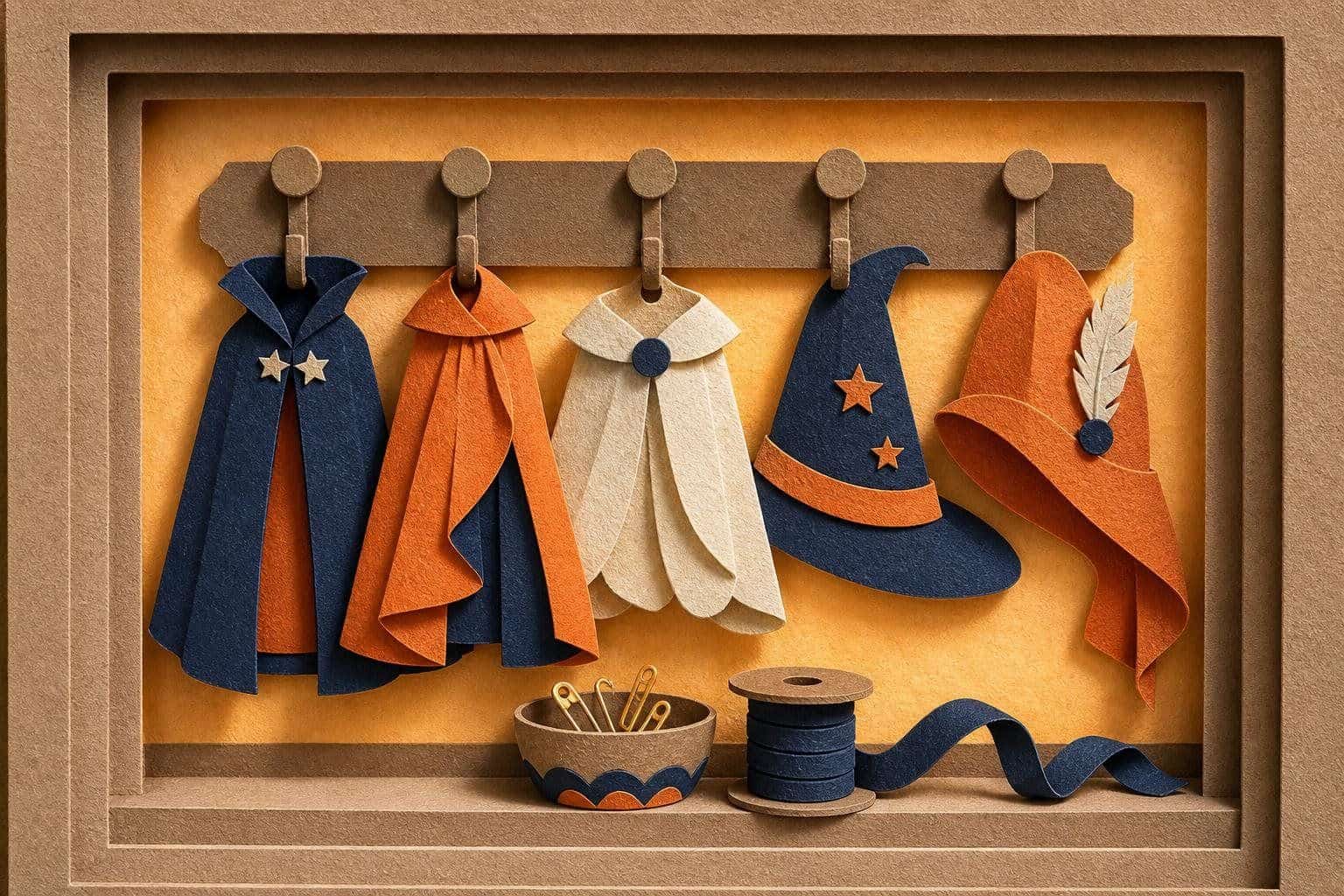
Group costume ideas work best when the theme is simple enough to recognize at a glance and flexible enough to fit very different people. This guide covers themes for three to five people, whether that is a family, a group of friends or a classroom team, along with how to coordinate on a budget and how to handle mixed ages and comfort levels. If you are choosing from scratch, the costume idea finder is a useful starting filter.
How a group costume works
A group costume has one shared idea and several individual roles. The shared idea might be a color, an object or a story. The roles give each person something to do. Choose a theme where every member has a clear part, and nobody is stuck as “the extra”.
Three questions settle most decisions:
- Who is the youngest, and what will they tolerate wearing for several hours?
- What does each person already own that fits?
- How much time does the group have, and who is in charge of the list?
Themes for three people
- The three little pigs. Pink clothes with felt ears and curly pipe-cleaner tails. Kind to young children.
- Traffic light. Red, yellow and green shirts with paper circles. Three people, a few minutes of work.
- Three musketeers. Hats with felt plumes, a sash and a cardboard sword with a rounded tip. See the costume ideas guide for further adventure themes.
- Chef, waiter and diner. From clothes in the closet, with an apron, a towel over the arm and a napkin.
Themes for four people
- Four seasons. Each wears a seasonal color with a prop: leaves, snowflakes, flowers, sun.
- Four food groups or a pizza. Each person wears a topping color with a cardboard cutout on the front, one person as the crust in cream.
- A band. A drummer, guitarist, singer and keyboard player with cardboard instruments. Every age can join.
- Garden and bugs. A gardener, a ladybug, a bee and a butterfly, using felt wings and headbands.
Themes for five people
- A superhero team. Each hero chooses a color and symbol, with capes built from the no-sew cape method.
- Planets and an astronaut. Color-coded paper circles pinned on dark clothes with one person as the astronaut. A good fit for a classroom.
- A box of crayons. Each person wears a color and a paper cone hat.
- Pirate crew. Captain, first mate, navigator, cook and ship’s parrot. The pirate costumes page has individual builds.
- Forest animals. Ears and tails on dark clothes, one distinct animal per person.
Group themes for classrooms
A class costume works when every child can finish theirs in under an hour at home, so ask for clothing-based builds. Keep the instructions to one page. Rainbow colors, farm animals, the solar system and book characters all scale up easily. Send the school’s costume rules to families, and agree one backup option for children who prefer not to dress up.
How to choose a theme
Run a ten-minute vote with these filters, in this order.
- Recognizable in two seconds. If you have to explain it, pick another.
- A role for everyone. Count the people, then count the roles. Mismatches create the person who is “just standing there”.
- Doable with what you own. The theme should survive a raid on the closet. If two items are missing, simplify.
- Comfortable for the whole evening. The youngest and the oldest set the limits.
- Easy to split up. Children run off, adults chat. A costume that still reads when two people are missing is more forgiving.
Matching without matching
Not every group wants identical outfits. Four ways to coordinate more loosely:
- One shared color, different pieces. Everyone in teal, each with a different hat, scarf or prop.
- One shared object. Everyone carries or wears the same object, such as an umbrella, a paper crown or a lanyard.
- Contrasts that belong together. Salt and pepper, a lock and a key, a sun and a moon, a cat and a dog.
- Same job, different tools. A team of chefs, doctors or explorers, each with their own item.
These formats are also a gift for groups with different ages, since each person decides how far to go.
A worked example: a family of four
Say the family has a parent, a teenager, a seven-year-old and a toddler, with a thirty-dollar budget at most and one evening. A theme such as “garden” fits: the toddler is a ladybug in a red shirt with black felt dots, the seven-year-old a bumblebee in a striped top and felt wings, the teenager a gardener in an apron and a straw hat, and the parent a scarecrow in a flannel shirt with raffia at the cuffs. Everything comes from clothes at home plus felt, tape and a few feet of raffia. The toddler’s costume is soft with no small parts, the teen’s is light, and each person has a clear role.
Common problems and how to solve them
- One person is bored by the idea. Let them propose a twist, or take the role of director.
- The youngest refuses the costume. Drop the costume piece, keep a color, and try again later with a different texture or a favorite toy.
- Everyone has a different opinion. Ask for two choices each, then pick the one that appears most often.
- The costume depends on a missing person. Build one that works with a stand-in prop, like a cardboard cutout.
- Photos are chaotic. Take the group picture first, before costumes get messy.
- Weather changes plans. Design the costume to go over a coat, or choose a theme where a warm layer is in character, such as a snowy day or an explorer’s jacket.
Coordinating on a budget
- Palette over purchases. Agree two or three colors. Everyone then finds something at home.
- One shared list. Write what each person owns, then list the gaps. One person gathers felt, tape or paper for everyone.
- Borrow and swap. Hats, belts and capes pass between households easily.
- Rule of one handmade piece. One handmade item per person ties the costume together and keeps costs low. A few dollars of felt or paper usually covers a whole group.
- Plan for reuse. Choose pieces a child can wear again to play.
Mixed ages and comfort levels
Babies and toddlers
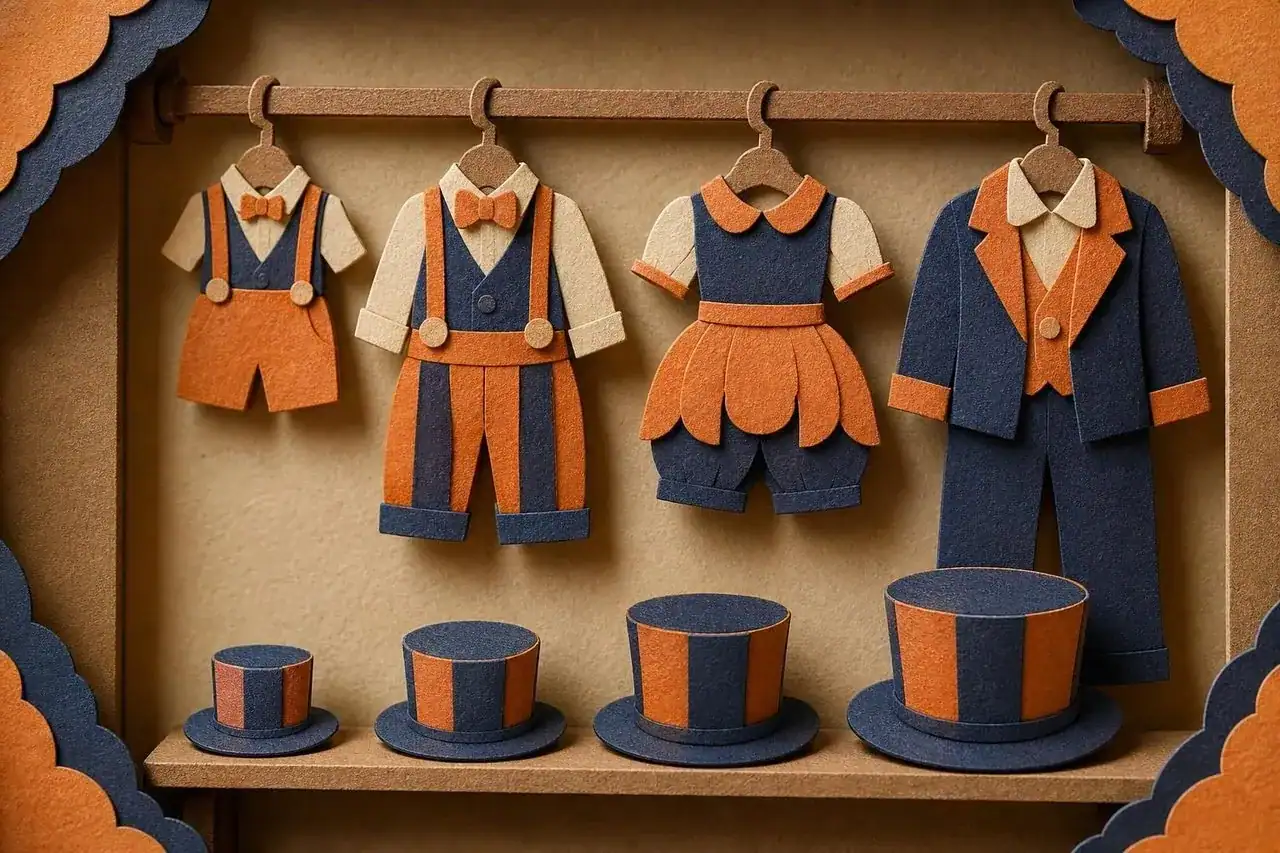
Build the group around the youngest. Soft, warm, no small parts, no neck ties, nothing on the face. A baby in an orange pumpkin outfit alone is enough, with the rest of the group as farmers or a garden.
School-age children
Give them a role, a prop to hold and a task, such as deciding the group’s name. Children this age often enjoy hand-making their own pieces. See no-sew kids Halloween costumes for tasks that suit each age.
Teens
Offer a flexible tier: a shared color and one accessory is a legitimate option. Let them design their own part. Do not force a teenager into face paint or a mask in front of friends.
Adults and grandparents
Choose comfortable shoes and breathable layers. Anyone who stands for a long time should avoid heavy headgear. Roles such as narrator, driver or photographer make more sense for some people than a full costume.
Sensory and comfort needs
Some children and adults cannot tolerate scratchy fabric, face paint or masks. Offer a version with soft fabric and a badge. Nobody should be pressured, and a group that respects that tends to feel more together, not less.
On the night
Take a picture early, since costumes wilt. Pack safety pins, tape and a spare headband. Hem anything long, check vision and add reflective tape for evening outdoors. The kids’ costume ideas and adult costume ideas cover age-specific ideas, and the DIY costumes index holds the full builds.
Questions people ask
What are good group costumes for three people?
How do you coordinate a group costume on a small budget?
What do you do when the group includes a baby or toddler?
How do you handle a teen who does not want to match?
What group themes work for a classroom?
Can a group costume work if people have different comfort levels?
How many people is best for a group costume?
How do you make a group costume funny without being offensive?
Should the group decide the costume together or have one person lead?
How can a family reuse a group costume?
Keep going