Christmas pageant and school play costumes
Christmas pageant costumes for angels, shepherds, wise men, innkeepers and elves, built fast for a whole cast, plus school hall quick-change logistics.
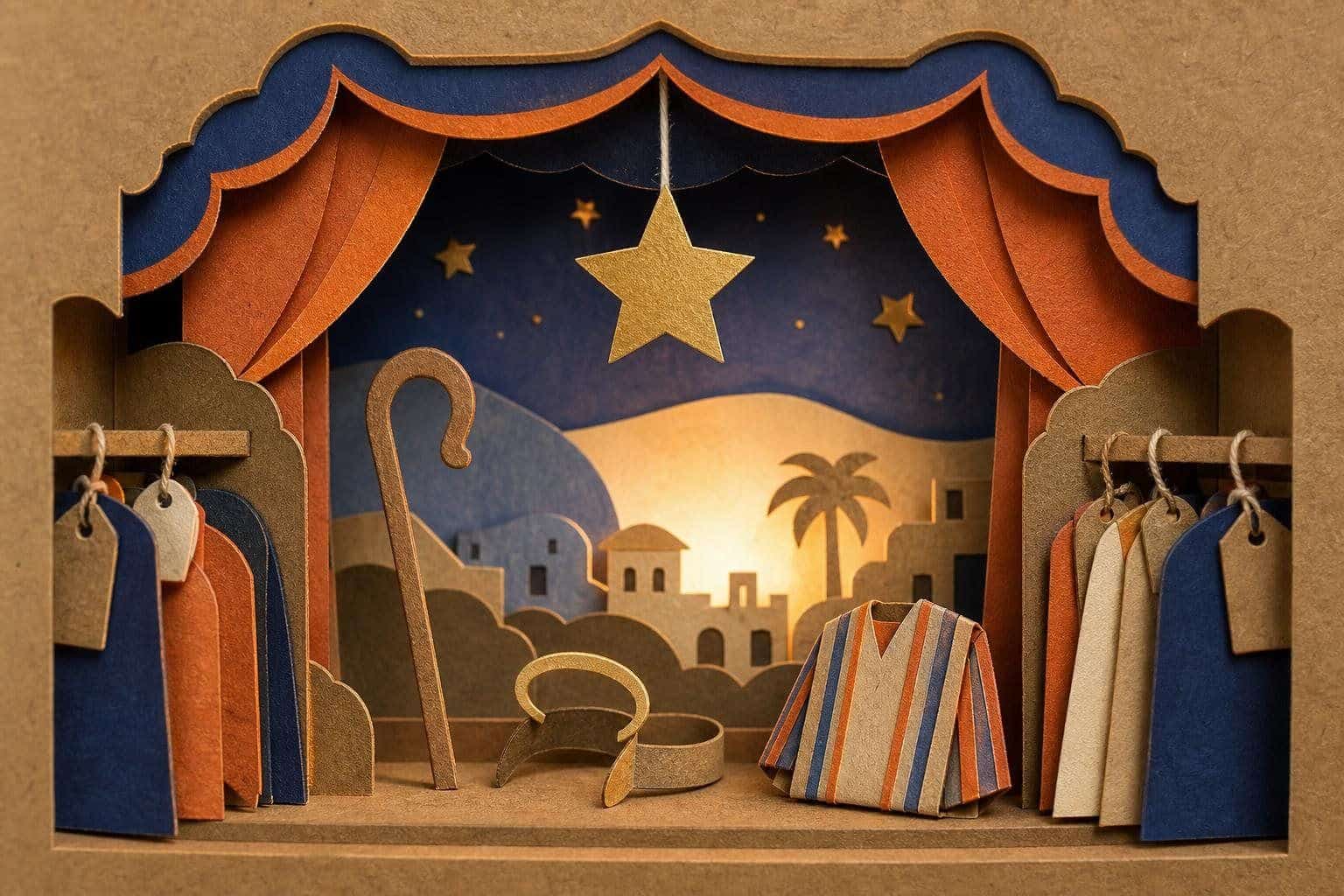
Christmas pageant costumes need to be fast, forgiving and easy to wear for twenty children at once. This guide covers the traditional roles, angels, shepherds, wise men, innkeepers and townspeople, along with elves and secular winter roles, and the practical side of running a school hall: quick changes, labels and storage. For the broader range of seasonal outfits, the Christmas costumes page is a good companion.
A note on tone. Nativity plays depict a religious story, and winter plays are often secular. Either way, children of different beliefs may take part, so keep casting open, costumes respectful and the focus on helping every child feel included.
Plan the whole cast first
Before making anything, write a list: roles, number of children, sizes and who will be in more than one scene. Then choose a base that fits all of them.
The base layer approach. Every child wears a plain long-sleeved shirt and leggings or trousers in a neutral shade. A robe, tunic or tabard goes over the top. This means a missing costume can be replaced, sizes vary less, and quick changes take seconds.
| Role | Base costume | Add-on | Time per costume |
|---|---|---|---|
| Angel | White tunic or pillowcase | Halo, wings | 15 minutes |
| Shepherd | Striped or brown robe | Towel headcloth, staff | 10 minutes |
| Wise man | Robe and sash | Foil crown, gift box | 20 minutes |
| Innkeeper | Apron over a plain tunic | Lantern with a battery light | 10 minutes |
| Townsperson | Everyday tunic, scarf | A basket or a hat | 5 minutes |
| Elf | Green or red top | Felt hat, pointed collar | 15 minutes |
The traditional roles
Angels
A white pillowcase with a head and arm holes cut, a halo from a gold pipe cleaner or tinsel bent into a ring on a headband, and wings cut from cardboard or white felt on elastic straps. Cut one template and trace it for the whole group. Keep wings narrow in a crowded space, and fix halos to a headband with tape so they do not slide into a child’s eyes.
Shepherds
The classic version is a bath towel folded over the head and tied with a strip of fabric, over a striped robe or a brown tunic with a cord belt. A staff from a cardboard tube or a dowel with a rounded end finishes the look. For small children, a stuffed toy lamb makes a good prop.
Wise men
Often shown as three, tradition names three gifts, gold, frankincense and myrrh, and the number three has followed from that. The gospel text does not state a number, so a play with more or fewer is correct as well. Dress them in richer fabrics: a bright robe, a sash, a foil-covered cardboard crown. Gifts are small boxes with the lids glued down, safe and easy to hold.
Mary and Joseph
Plain, humble robes in blue, brown or cream. A shawl or headcloth for Mary and a cord belt and a headband for Joseph. Choose neutral colors so any child can step in.
Innkeepers and townspeople
An innkeeper is a role added by tradition. The story mentions only that there was no room at the inn. Give them an apron, a towel and a lantern with a battery tea light. Townspeople wear everyday ancient-style clothing: a long tunic, a scarf and a basket. These roles suit children who want a smaller part, and a crowd scene gives every child a place.
Animals and the star
A donkey, sheep and cow can be made from hooded sweatshirts with felt ears. A child who carries the star holds a card star on a stick. Hold it above the head, with the stick lighter than a school ruler.
Elves and secular winter roles
Plenty of schools run winter plays with no religious content. These roles need very little:
- Elves. A green or red top, a felt hat with a pointed tip, a paper collar with zigzag edges, and soft shoes. See the fantasy and elf costumes page for more elaborate looks.
- Snowflakes and snowmen. A white shirt, a paper snowflake pinned on the front, a plain scarf, or a felt carrot nose on a headband. Avoid any loose cotton wool near heat.
- Woodland animals. Ears on a headband and a tail from a rolled sock.
- Toy-workshop characters. An apron, a paper hat, and cardboard toys carried in a box.
- Clock-makers, bakers and gingerbread figures. Plain clothes plus one clear item, in line with the historical costumes approach.
Building costumes for many children at once
When twenty or more children need costumes, an assembly line beats individual work.
- Cut once. One tunic pattern, folded fabric or a pillowcase template, traced onto everything.
- Two sizes only. Make small and large and let children choose.
- Parents’ evening. One session where families cut, glue and pin together, with a table per piece.
- Sort by task, not by child. One table for halos, one for headcloths, one for crowns. Each table repeats the same step.
- Use what exists. Bath towels, bed sheets, old curtains and dressing gowns have been Nativity costumes for generations.
- Keep a spares box. Extra headbands, safety pins, tape and a few plain tunics for emergencies.
Fabrics and colors
Plain cotton or flannel in muted colors suits shepherds, townspeople and Mary and Joseph. Heavier or shinier fabric, such as a satin sash, suits wise men and kings. White cotton is the angel standard. Avoid synthetic tinsel on anything worn near candles and open flame, and avoid itchy trims close to a child’s neck. Test every costume on a child of the right size before making twenty.
Respectful casting and costume choices
A few habits make the play welcoming for everyone.
- Offer roles openly. Let children volunteer for any part that fits, and do not assign roles by background.
- Provide secular roles. Narrators, animals, stagehands and winter characters give every child a place.
- Keep costumes dignified. Robes and headcloths represent a historical setting. Avoid comic exaggeration of any region or people.
- Do not assume belief. Say that all families are welcome, and invite questions in private.
- Explain the story simply. Children dressed for a role usually do better when they know what the character is doing and why.
Rehearsal tips for costumes
Run at least one rehearsal in full costume. Watch for sleeves that hide hands, hems that trip, halos that drop, and crowns that block the view. Children learn to move in a long robe by walking slowly with small steps, and a practice run on the real stage steps is worth the time. Take a photograph of every child in costume, so you can rebuild the outfit quickly if a piece goes missing.
School hall logistics
Quick changes
- Base layer under, costume over, as above.
- Velcro, snaps or large buttons only.
- Put each costume on a labeled hanger, in the order of scenes.
- Rehearse the change with a stopwatch once.
- One adult helper per side of the stage.
Labels
Write each child’s name and role on fabric tape inside every piece. Keep a master list on a clipboard with the number of pieces per child. At the end of the show, count before dismissing anyone.
Storage
Use a clothes rail or a row of chairs at the back of the hall, with a plastic bag for each child’s small items such as halo and sash. Store everything in one labeled box afterwards so next year’s cast starts with a basis.
Safety on a school stage
Hem long robes above the ankle, secure headpieces with elastic or clips, and keep props light with rounded ends. Use battery lights, never flame. Check the floor for cords and steps. The kids’ costume ideas has more on age-appropriate safety, and the group and family costume ideas guide helps with coordinating larger groups.
Time plan
- Six weeks out: settle roles and send families a short list.
- Four weeks: gather materials and make templates.
- Two weeks: first try-on and fixes.
- Dress rehearsal: full run with quick changes.
- After the show: wash, repair and box everything for next time.
For further builds, the DIY costumes index lists full projects.
Questions people ask
What do you need for a simple shepherd costume?
How do you make angel costumes for a large group?
What did people in the Nativity story actually wear?
How should a play handle children of different beliefs?
Are there secular winter play roles?
How can you manage quick changes backstage?
How do you label costumes in a school hall?
What is the cheapest way to do wise men or kings?
How do you keep costumes safe on stage?
How early should a play's costumes be organized?
Keep going